Service
Wound Care in Elk Grove Village, IL for Diabetic Foot Ulcers and Slow-Healing Wounds
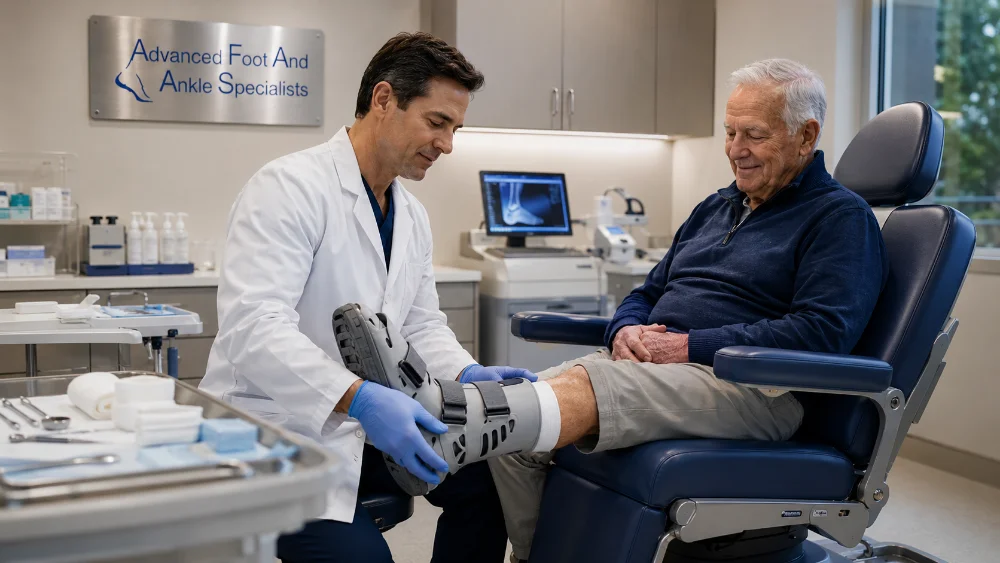
A foot wound that will not close, especially for anyone living with diabetes, is not something to wait out. When circulation is limited or the nerves in the feet have lost feeling, a small blister, cut, or pressure sore can quietly turn into a foot ulcer that stalls and grows serious. Advanced Foot and Ankle Specialists provides podiatric wound care at all four of its offices, in Elgin, Elk Grove Village, Huntley, and the Montclare neighborhood of Chicago. This page focuses on wound care at the Elk Grove Village office, in Suite 3004 of the Brock Medical Building on the Ascension Alexian Brothers Medical Center campus, where care is led by board-certified podiatrists, including Dr. Craig Halihan, whose training includes wound care and diabetic limb salvage. Care centers on careful evaluation, debridement of dead tissue, offloading to take pressure off the wound, and management of infection, so the foot has the best chance to heal.
Request Your Elk Grove Village Visit | Call (847) 352-0200
★ Dr. Halihan holds a 4.98 out of 5 rating across 53 patient reviews, part of a review record patients across the northwest suburbs point to when they choose Advanced Foot and Ankle Specialists for careful, conservative foot and ankle care.
Last Updated: August 27, 2026
A foot wound is anything that breaks the surface of the skin on the foot, from a cut or abrasion to a blister, a pressure sore, or a diabetic foot ulcer that does not close on its own. Podiatric wound care is the focused treatment a foot and ankle specialist provides to help these wounds heal and to lower the chance of infection or further tissue damage. Because the feet bear body weight and circulation can be limited, especially for patients with diabetes or vascular disease, wounds there may behave differently from a scrape on the arm or hand.
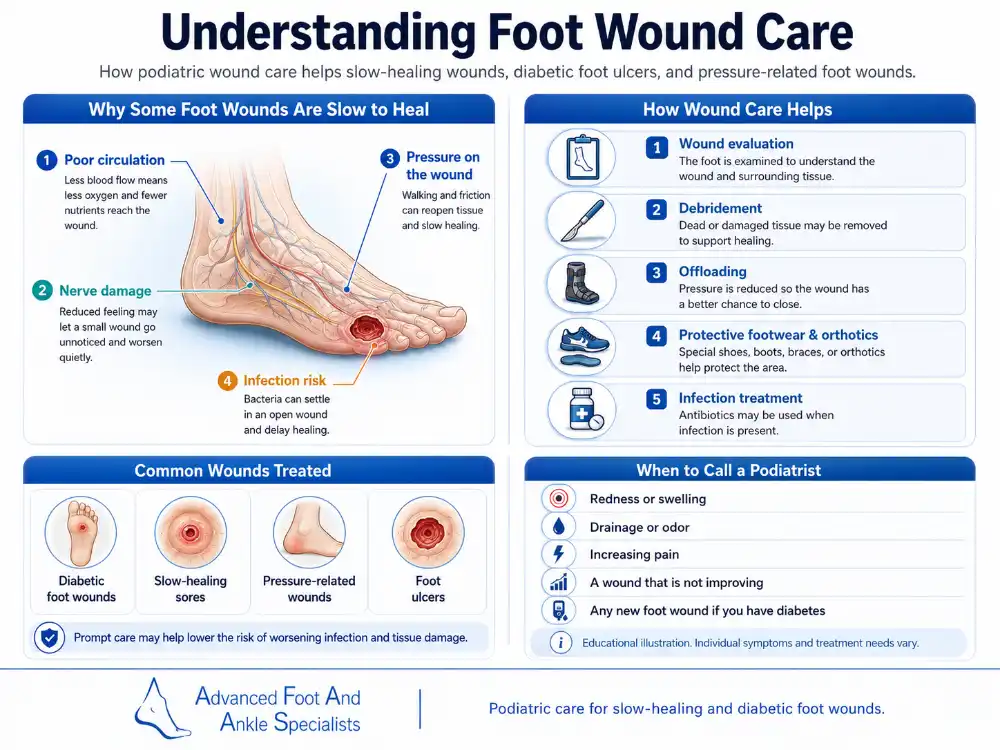
Healthy skin usually starts repairing itself within a day or two. When a foot wound stalls, it is almost always because one or more healing conditions are not being met. Poor circulation limits the oxygen and nutrients a wound needs to close. Nerve damage, known as neuropathy, dulls the feeling that would normally tell you a wound is there. Steady pressure from standing and walking can reopen tissue with every step. And an open wound is an entry point for bacteria that can slow or stall healing. A podiatrist looks at all of these factors together, which is what separates true wound care from simply cleaning and bandaging a cut.
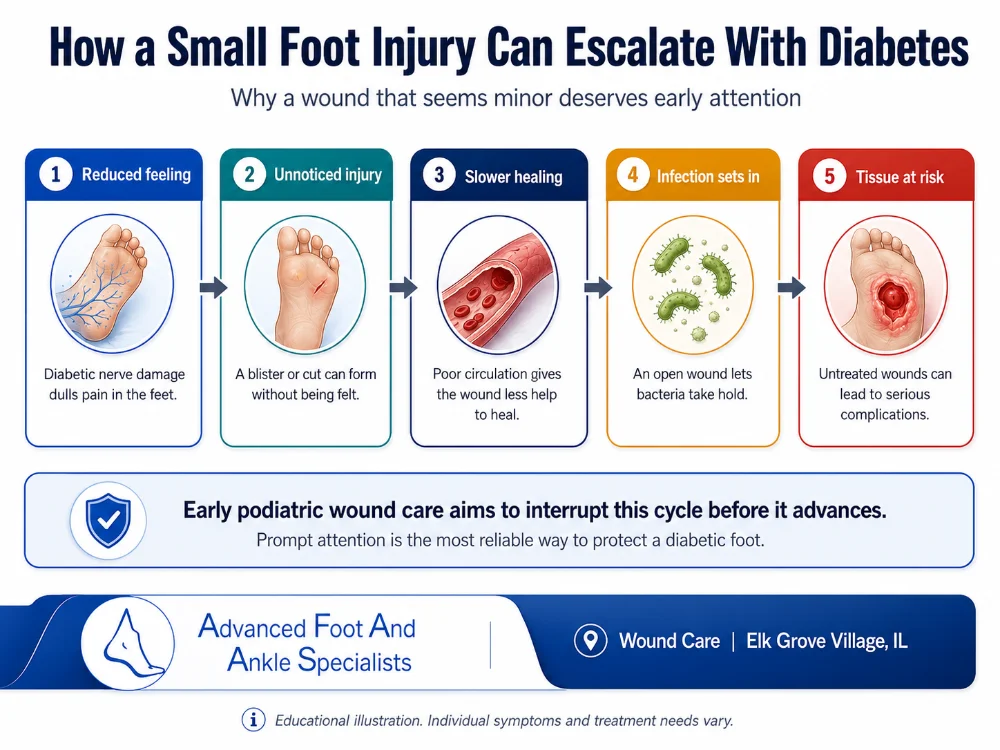
Diabetes changes how a foot wound behaves in three ways at once, and that combination is what makes diabetic foot wound care so important. High blood sugar over time damages the nerves in the feet, so a person may not feel a blister forming inside a shoe or a small cut on the sole. The same disease narrows and stiffens blood vessels, which means less blood reaches the wound to heal it. Diabetes also weakens the body's ability to fight infection. A wound that a healthy person might shrug off can, for someone with diabetes, become a foot ulcer that lingers for weeks.
Left unattended, a diabetic foot ulcer can become infected, and a deep infection can move into surrounding tissue and bone. In the most serious cases, this is the path that can lead to tissue loss and, at the far end, amputation. The point of raising this is not to alarm, but to explain why prompt, consistent care matters so much. Catching a diabetic foot wound early and managing it closely is one of the most important ways to interrupt that cycle before it advances, which is exactly what a diabetic wound care plan is built to do.
A diabetic foot ulcer is an open sore that can develop when reduced sensation, repeated pressure, and circulation problems interfere with normal healing. Neuropathy may make a blister, callus, or small injury difficult to feel, while continued pressure can allow the wound to worsen. Ulcers often form on the sole, toes, or areas that rub against footwear, and pain alone is not a reliable measure of severity. Our guide to how diabetes affects wound healing explains how sensation, circulation, blood sugar, and infection risk can influence healing.
Can a diabetic foot ulcer be serious even if it does not hurt? Yes. Diabetic neuropathy can reduce feeling in the feet, so an ulcer may cause little or no pain even when tissue damage is present. Regular foot checks are important because pain may not provide an early warning.
When should someone with diabetes have a foot wound checked? A new foot wound should be evaluated promptly if you have diabetes, particularly if it is getting larger, draining, becoming red or swollen, developing an odor, or not improving. Reduced sensation can make it difficult to judge the seriousness of a wound by how it feels.
A venous ulcer can develop when problems with the veins make it difficult for blood to return efficiently from the lower leg toward the heart. Persistent venous pressure and swelling can gradually affect the skin and surrounding tissue, with ulcers most commonly developing around the ankle or lower leg. Our guide to how circulation problems affect wound healing explains this relationship in more detail.
Persistent lower-leg or ankle swelling, aching or heaviness, brown or reddish skin discoloration, changes in skin texture, and an open sore that is slow to close can occur with chronic venous disease. These findings do not confirm the cause of a wound on their own, so professional evaluation remains important. Patients noticing changes before a wound opens can also review the early warning signs of venous stasis ulcers.
Evaluation focuses on both the wound and factors that may be affecting circulation. Venous ulcers differ from many diabetic foot ulcers because the underlying problem involves impaired venous return rather than primarily neuropathy and pressure. Some patients may have more than one circulation problem at the same time.
Compression can be part of venous ulcer management, but it is not appropriate for every patient. Arterial circulation may need to be considered before compression is recommended. When additional vascular evaluation or treatment is needed, the podiatrist can coordinate referral to the appropriate specialist.
How is a venous ulcer different from a diabetic foot ulcer? Diabetic foot ulcers are commonly associated with neuropathy, pressure, and diabetes-related healing problems, while venous ulcers are associated with impaired blood return through the veins of the lower leg. An evaluation helps determine what is contributing to the wound before treatment is selected.
Should I use compression socks on a venous ulcer? Do not start compression solely because a wound appears to be venous. Compression can help some venous ulcers, but it is not appropriate for every circulation problem. The wound and circulation should be evaluated first.
A puncture wound occurs when a pointed object creates a small opening in the skin while potentially reaching deeper into the foot. Nails are a common cause, but glass, wood, metal, needles, and other sharp objects can cause similar injuries. Because the opening can look much smaller than the injury underneath it, a puncture wound should not be judged by appearance alone.
The podiatrist examines where the object entered the foot, the surrounding tissue, and any signs of infection, retained material, or deeper injury. How and when the injury occurred, what caused it, and whether the object passed through footwear can also influence the evaluation.
Imaging may be helpful when a retained object or deeper injury is suspected. Advanced Foot and Ankle Specialists has in-office X-ray and ultrasound available when appropriate. Tetanus vaccination status may also need to be reviewed after a puncture injury.
Do not dig into the wound, cut tissue away, or attempt to remove deeply embedded material yourself. Professional evaluation is especially important when the wound is deep or contaminated, an object may remain inside the foot, or redness, swelling, warmth, drainage, increasing pain, or fever develops. Patients with diabetes, neuropathy, poor circulation, or a weakened immune system should have an even lower threshold for seeking care.
What should I do if I stepped on a nail or another sharp object? Do not dig into the wound or try to cut tissue away yourself. Protect the area and arrange a professional evaluation, ideally within 24 hours, particularly if the object penetrated deeply, passed through a shoe, part of it may remain in the foot, or you have diabetes, neuropathy, or circulation problems. Your tetanus vaccination history may also need to be reviewed.
Will I need an X-ray for a foot puncture wound? Not every puncture wound requires imaging. Your podiatrist determines whether an X-ray, ultrasound, or other evaluation may be useful based on what caused the injury, how deep it appears to be, the examination findings, and whether there is concern about a retained object or deeper injury.
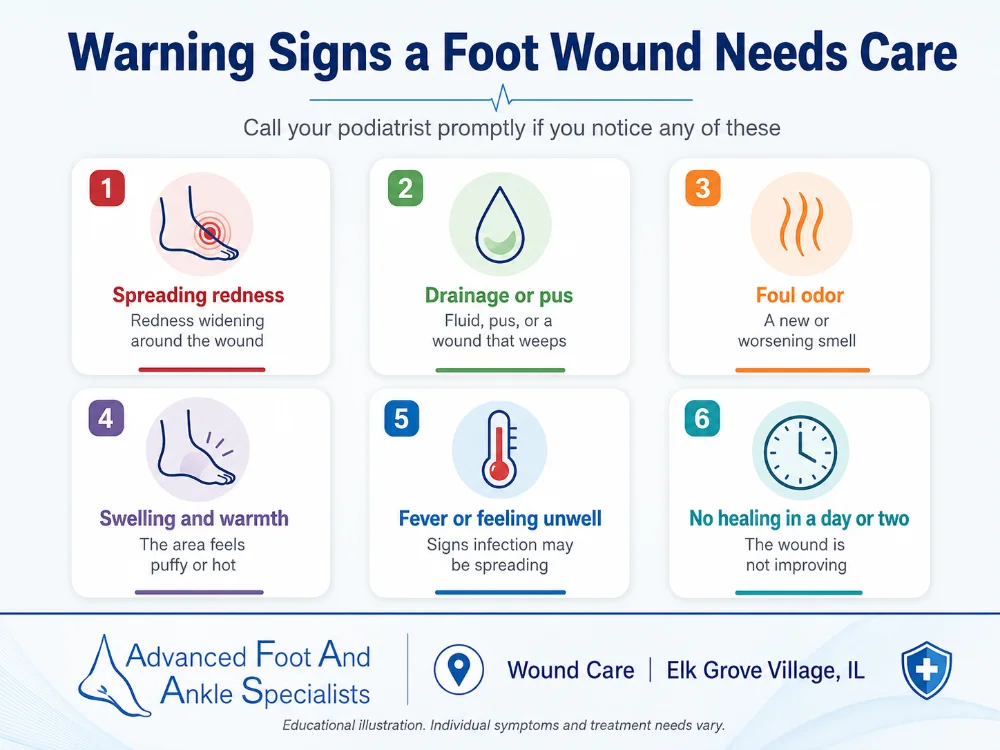
Not every foot wound needs an office visit on day one, but certain signs mean it is time to have a podiatrist take a look rather than continuing to treat it at home. If you have diabetes, poor circulation, or a weakened immune system, the threshold is lower and it is worth calling sooner. Watch for any of the following:
• Redness that is spreading outward from the wound rather than staying at the edges.
• Drainage, pus, or fluid weeping from the wound.
• A new or worsening odor coming from the wound or the dressing.
• Swelling, warmth, or increasing pain around the area.
• Fever, chills, or generally feeling unwell, which can signal a spreading infection.
• Skin around the wound that is turning dark, gray, or black.
• No sign of improvement after a day or two, or a wound that keeps getting larger.
If you notice these signs, contact Advanced Foot and Ankle Specialists rather than waiting. For a wound that looks severely infected or comes with sudden, significant pain or color change, seek care promptly, since those situations can move quickly.
Anyone with a deep cut, non-healing foot wound, puncture injury, or ulcer should consider podiatric evaluation. Earlier attention is especially important for people with diabetes, peripheral artery disease or other circulation problems, neuropathy, a weakened immune system, or a history of foot ulcers.
If you are otherwise healthy and the wound is minor, keep it clean and protected and watch it closely. Schedule an evaluation if it is not improving, begins to worsen, or develops redness, drainage, odor, swelling, increasing pain, or another warning sign.
A wound care visit is built around understanding your wound and then giving it what it needs to heal. Your podiatrist begins by examining the foot to learn the type and depth of the wound, checking the surrounding skin, circulation, and sensation, and using in-office X-ray or ultrasound when a closer look is helpful. From there, care usually follows the same general path, tailored to your wound and your overall health.
Debridement is often the next step, removing dead or damaged tissue to help create a healthier wound bed and support healing. Offloading takes pressure off the wound so it is not reopened with every step. Infected wounds may call for antibiotics and a protective dressing, and every plan includes monitoring, with follow-up visits to track healing and adjust the approach as the wound improves.
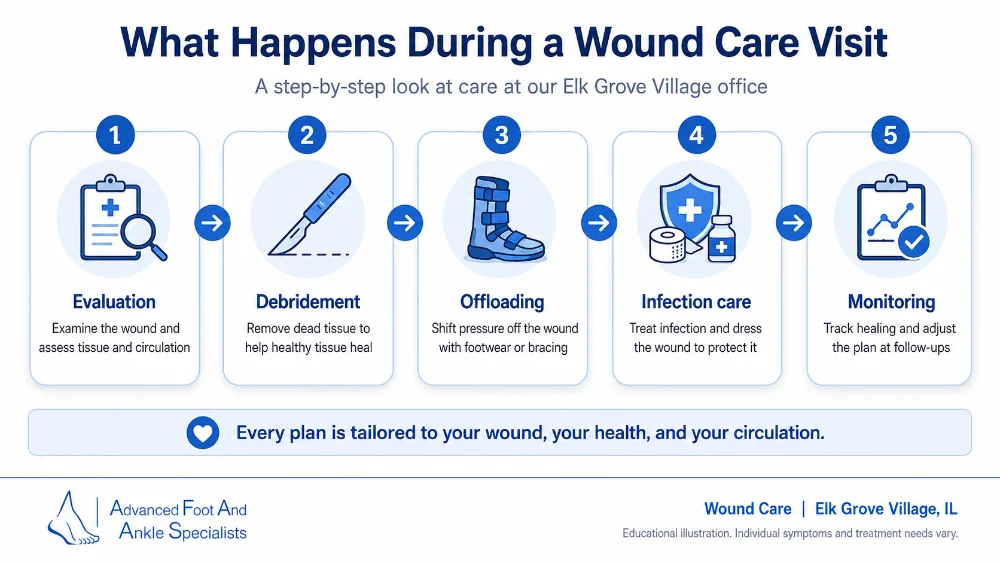
Offloading is one of the most important and most overlooked parts of foot wound care. A wound on the bottom of the foot sits directly under the body's weight, so ordinary walking can reopen it again and again, no matter how well it is dressed. Offloading redistributes that pressure using tools like custom orthotics, protective footwear, a surgical shoe, a walking boot, or a brace. By shifting weight away from the wound, offloading gives the tissue a better chance to progress without repeatedly reopening.
Care is matched to the wound in front of us. The options below are the ones our Elk Grove Village podiatrists commonly draw on for foot wounds, from a straightforward cut or puncture injury to a stubborn diabetic or circulation-related ulcer.
Every plan starts with a careful evaluation of the wound, the tissue around it, and the circulation and sensation in the foot. This is where your podiatrist identifies why a wound is not healing and decides which steps will help it most.
Debridement is the removal of dead or damaged tissue from a wound. Clearing that tissue can help create a healthier wound bed and support healing, and it may be repeated at follow-up visits as the wound changes.
Offloading shifts pressure away from the wound using orthotics, special shoes, a boot, or a brace so the foot can heal while you stay mobile. Protective footwear can also lower the risk of a new wound forming, which matters most for patients with diabetes or neuropathy.
When a wound shows signs of infection, antibiotics may be used to control it and protect your overall health. If antibiotics are prescribed, it is important to take the full course as directed, even if the wound starts to look better.
For patients with diabetes, prevention is a core part of care. Regular foot checks, monitoring of healing wounds, and guidance on footwear and daily foot care help catch problems early, when they are far easier to manage.
For complex diabetic foot wounds, Dr. Halihan brings specific training in diabetic limb salvage to the team. That experience shapes how the most serious wounds are evaluated and managed, with the goal of protecting the foot.
When a wound shows signs of severe infection or significant circulation problems, your podiatrist can coordinate care and referrals to the appropriate specialists, so important issues are not overlooked and the wound is managed by the right team at every stage.
Wound care is offered at all four Advanced Foot and Ankle Specialists offices. At the Elk Grove Village office, it includes:
Healing time depends on the wound's size and depth, circulation, pressure on the area, infection risk, and overall health. Diabetic and other chronic foot ulcers may require closer follow-up than minor wounds, so your podiatrist can give a more individualized outlook after evaluating the foot.
When a wound remains open, identifying what is delaying healing becomes especially important. Our guide to advanced wound care for chronic foot ulcers explains how pressure, circulation, infection risk, and the condition of the wound can influence progress. Follow-up visits allow your podiatrist to monitor healing, repeat debridement when appropriate, and adjust offloading, dressings, or other parts of the plan.
What you do at home has a real effect on how a foot wound heals. These steps help protect the wound and lower the risk of infection between appointments:
Wound care at Advanced Foot and Ankle Specialists is provided by podiatrists trained in foot and ankle surgery, including providers with board certification through the American Board of Foot and Ankle Surgery. Their experience includes diabetic wound care, limb salvage, trauma, and complex foot conditions. In-office X-ray and ultrasound are also available when additional evaluation is appropriate.
Craig Halihan, DPM: Board-Certified Podiatrist and Wound Care Lead
Dr. Halihan has specialized training in wound care and diabetic limb salvage, along with trauma and reconstructive foot and ankle surgery. He is board certified in foot surgery and reconstructive rearfoot and ankle surgery through the American Board of Foot and Ankle Surgery. His wound-care and limb-salvage background is particularly relevant when evaluating complex diabetic foot wounds, and he holds a 4.98 out of 5 rating across 53 patient reviews.
Haris Khan, DPM: Board-Certified Podiatrist
Dr. Khan's training includes diabetic wound care, limb salvage, external fixation, foot and ankle trauma, and complex reconstruction. He is board certified in foot surgery and reconstructive rearfoot and ankle surgery through the American Board of Foot and Ankle Surgery and uses a conservative, evidence-based approach to care.
Matthew Krouse, DPM: Board-Certified Podiatrist
Dr. Krouse has extensive training in wound care, trauma, limb salvage, and external fixation. He is board certified in foot surgery and reconstructive rearfoot and ankle surgery through the American Board of Foot and Ankle Surgery and combines surgical training with a conservative, patient-focused approach.
Patients with foot wounds often need more than a single dressing change. Advanced Foot and Ankle Specialists combines wound-care experience with ongoing podiatric follow-up at its Elk Grove Village office.
Do I need a referral to be seen for a foot wound? Not always. Many patients contact the Elk Grove Village office directly, though some insurance plans require a referral for coverage. The front desk can check what your specific plan needs before your visit.
How soon can I be seen if my foot wound is getting worse? Call (847) 352-0200 to ask about the earliest available appointment, especially if the wound is worsening, you have diabetes, or you notice signs of infection.
Where exactly is the Elk Grove Village office, and is parking available? The office is in Suite 3004 of the Brock Medical Building at 800 Biesterfield Road, on the Ascension Alexian Brothers Medical Center campus, with on-site parking available on the medical campus. The front desk can help confirm the closest entrance and parking guidance before your visit.
Patients come to the Biesterfield Road office for wound care from across Elk Grove Village and the surrounding northwest suburbs. Common areas we see wound care patients from include:
An open foot wound can make standing, walking, working, and staying active more difficult. For people who work around the Elk Grove Village Business Park or spend time near local areas such as Busse Woods, care at the Biesterfield Road office provides a nearby option for evaluation and follow-up, with weekday hours that include Tuesday evening appointments.
The reviews below reflect recent patient feedback about care at Advanced Foot and Ankle Specialists. Wound care and diabetic foot patients often mention feeling informed and unhurried, and condition-specific reviews are featured here as they come in.
“I am very pleased with the treatment I received at Advanced Foot and Ankle Specialists. Dr. Halihan listened to my concerns about the pain I have in my foot, he then examined my foot and ankle which has extensive damage and discussed a course of action. My foot and ankle are much better and the pain is almost gone in less than 8 hours after treatment. I will continue seeing Dr Halihan for any further treatment if needed.”
“Dr. Krouse was professional and to the point. Got me in and out quickly.”
“Dr Khan was really awesome & made us understand everything about my father's feet.”
Call (847) 352-0200 or schedule online to start a wound care consultation with the Advanced Foot and Ankle Specialists team. The front desk can help you ask about the earliest available Elk Grove Village appointment, and if you have diabetes or a wound that is getting worse, let them know so the team can guide you on appropriate next steps. They will also explain what to bring and what to expect at a first wound care visit.
Call (847) 352-0200 | Request Your Elk Grove Village Visit
Advanced Foot and Ankle Specialists 800 Biesterfield Rd, Alexian Brothers Medical Center, Brock Medical Building, Suite 3004, Elk Grove Village, IL 60007
A podiatrist is a doctor of podiatric medicine who focuses on the feet and ankles, including the wounds that form there. Some wound care specialists treat wounds anywhere on the body, often in a hospital wound center. For foot wounds and diabetic foot ulcers, a podiatrist brings specific expertise in how the foot heals, moves, and bears weight.
Yes. Treating foot wounds is a core part of podiatric care. A podiatrist can evaluate the wound, remove dead tissue, offload pressure, manage infection, and monitor healing over time, and can coordinate referrals if a wound needs additional specialist input.
Yes. Debridement, the removal of dead or damaged tissue from a wound, is a common in-office podiatric procedure. Clearing that tissue can help create a healthier wound bed and give healthy tissue a better chance to heal.
That is decided during an evaluation. A podiatrist looks for dead or thickened tissue, debris, or a callus rim around the wound that can slow healing. If those are present, debridement is often recommended, and it may be repeated at follow-up visits.
Circulation in the feet can be limited, especially for people with diabetes or vascular disease, and the feet bear weight with every step, so pressure can keep reopening healing tissue. Nerve damage and conditions like diabetes add to the delay. That combination is why a foot wound may need professional care that a wound elsewhere would not.
Early signs can include numbness, tingling, or a loss of feeling in the feet, along with dry or cracking skin, calluses, or a small blister or sore you did not feel form. Because sensation is reduced, these can go unnoticed, which is why regular foot checks matter for people with diabetes.
It varies with the wound's size, depth, circulation, and how consistently pressure is kept off it. Some wounds improve over a few weeks, while diabetic foot ulcers can take longer and need close follow-up. Your podiatrist can give a more specific outlook once the wound is evaluated.
Keeping pressure off the wound through offloading, changing dressings as instructed, keeping the area clean and protected, managing blood sugar, and attending follow-up visits all support healing. Removing dead tissue and controlling infection when present also help the wound progress.
It can be serious and should not be ignored. An infection in a diabetic foot can spread into deeper tissue and bone, and in severe cases it can threaten the foot. Early treatment is one of the most important ways to reduce the risk of an infection advancing, so call promptly if you notice warning signs.
Possible complications include infection, deeper tissue and bone involvement, chronic non-healing ulcers, and, in the most serious cases, tissue loss or amputation. Consistent wound care aims to lower these risks by catching problems early and keeping the wound protected.
Usually not without protection, because pressure and friction can keep the wound from closing. Your podiatrist may recommend offloading with special footwear, a boot, a brace, or orthotics so you can stay mobile while taking weight off the wound. Following those instructions closely often makes a real difference in healing.
Many wounds are seen on a regular schedule, sometimes weekly, so tissue can be checked, debrided if needed, and re-dressed. The exact cadence depends on the wound and how it is responding, and your podiatrist will adjust the follow-up plan as the wound improves.
Advanced Foot and Ankle Specialists accepts a wide range of insurance plans. The office can verify your specific coverage before your visit, so you know what to expect, and the front desk is happy to answer coverage questions when you call.
Bring your insurance card and a photo ID, a list of your current medications, and any details about the wound and how long it has been present. If you have diabetes, recent blood sugar information is helpful, and it is best to wear or bring shoes that are easy to remove.
Yes. A non-healing foot wound is a common reason patients come in. The podiatrist will look at why the wound has stalled, whether it is pressure, circulation, infection, or tissue that needs debridement, and build a plan from there. A fresh evaluation often uncovers a factor that can be addressed.
If you want a podiatry team that will take the time to understand what is behind a wound that will not heal, explain your options in plain language, and build a plan aimed at supporting wound healing and helping you stay as mobile as safely possible, Advanced Foot and Ankle Specialists is ready to help. Whether it is a diabetic foot ulcer, a circulation-related ulcer near the ankle, a puncture wound, an infected cut, or another slow-healing wound that has lingered too long, reach out and let the Elk Grove Village team take a look.
Start Your Wound Care Plan in Elk Grove Village
Request Your Elk Grove Village Visit | Call (847) 352-0200
Advanced Foot and Ankle Specialists 800 Biesterfield Rd, Alexian Brothers Medical Center, Brock Medical Building, Suite 3004, Elk Grove Village, IL 60007
Hours:

Our team is ready to help you feel your best, one step at a time!