Service
Heel Pain Treatment in Elk Grove Village, IL From Board-Certified Podiatrists
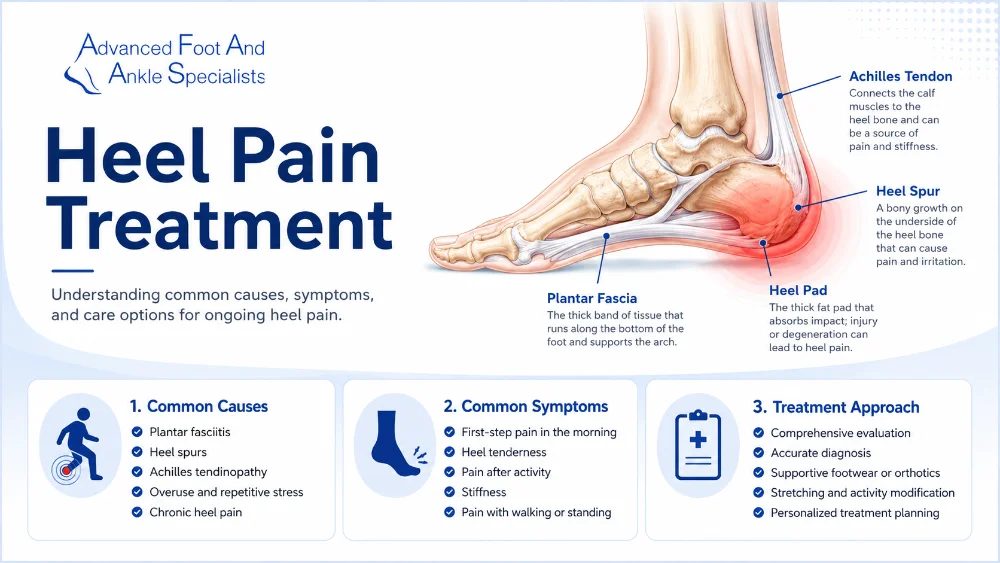
That first sharp step out of bed in the morning, or the ache that returns the moment you sit down after a long shift, is how heel pain often makes itself known. Heel pain can persist when its underlying cause is not addressed, and the right treatment depends on identifying what is contributing to it. Advanced Foot and Ankle Specialists treats heel pain at its Elk Grove Village office in Suite 3004 of the Brock Medical Building, on the Ascension Alexian Brothers Medical Center campus at 800 Biesterfield Road, with the same care available at the Elgin, Huntley, and Montclare, Chicago offices. Board-certified podiatrists Craig Halihan, DPM, Haris Khan, DPM, and Matthew Krouse, DPM work to identify the source of the pain and build a plan that can range from supportive footwear and custom orthotics to advanced options when symptoms persist.
Book Your Elk Grove Village Appointment | Call (847) 352-0200
Last Updated: August 27, 2026
Heel pain treatment is the work of finding out why a heel hurts and then matching care to that specific cause. Heel pain can begin as a mild inconvenience and progress until it interferes with walking, standing, exercise, and work. Because several different problems can produce pain in the same area, an accurate diagnosis helps guide effective treatment. Plantar fasciitis is one of the most common causes of heel pain, but heel spurs, Achilles tendinitis, stress fractures, bursitis, and nerve-related pain can each present differently and call for a different plan.
The patients seen for heel pain tend to fall into a few groups. Some are on their feet through long shifts and arrive with first-step morning pain that will not settle down. Others are runners or active adults who added mileage or intensity too quickly and now feel pain at the back or bottom of the heel. A number are managing diabetes and need heel pain that comes with numbness or a slow-healing sore looked at without delay. Each starts with a focused evaluation, in-office X-ray or ultrasound when it helps, and a plan built around the actual cause rather than a single default treatment.
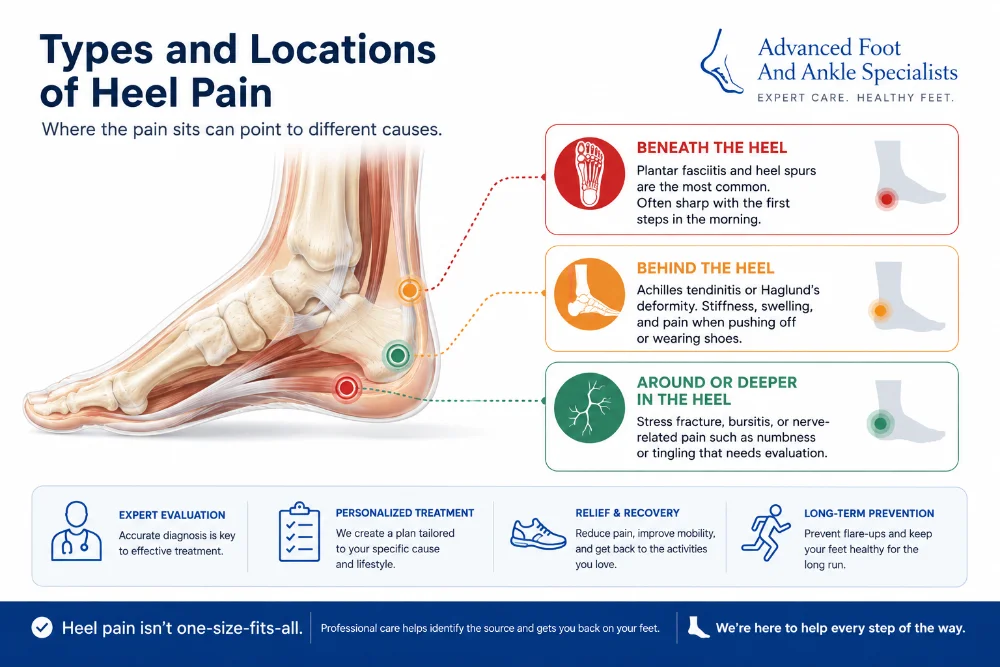
One of the first questions during an evaluation is where the pain sits, because the location often points toward the cause. Pain beneath the heel is often associated with plantar fasciitis. A heel spur may appear on imaging but is not always the source of the pain. Pain and stiffness behind the heel can suggest an Achilles problem, sometimes with swelling or pain when pushing off. Pain that is deeper or spread around the heel can involve a stress fracture, bursitis, or nerve-related pain such as numbness or tingling. This section may help patients understand possible causes, but a clinical evaluation and, when needed, imaging are used to identify the condition contributing to the pain.
Heel pain care is provided at the Elk Grove Village office in Suite 3004 of the Brock Medical Building, at 800 Biesterfield Road on the Ascension Alexian Brothers Medical Center campus. Patients from nearby Elk Grove Village neighborhoods and business corridors can reach the campus from Biesterfield Road. On-site parking is available, and patients can confirm the closest entrance and parking guidance when booking.
Elk Grove Village is the primary office for this page, and the same heel pain care is available across the practice. Advanced Foot and Ankle Specialists also treats heel pain at its offices in Elgin, Huntley, and the Montclare neighborhood of Chicago, and provider availability may vary by office and appointment date, so patients can confirm which podiatrist is scheduled when booking. Patients can choose whichever office is most convenient and still see a provider whose approach fits their case.
Elk Grove Village patients have choices for heel pain care, and the ones who choose this practice tend to point to the same reasons. The points below reflect what shapes care here and what patients highlight after a visit.
“I’ve been going there for a few years and everyone is pleasant and welcoming. Dr. Halihan always takes his time and gives options on the treatment, doing what’s best for his patients. Recommend this place to anyone who needs their services.”
Behind every heel pain plan is a goal that matters in daily life. These are four of the outcomes Elk Grove Village patients most often work toward.
The first outcome is clarity. Because sharp pain beneath the heel, stiffness behind the heel, and deeper aching can each point to different problems, the evaluation focuses on naming the cause. That diagnosis is what makes the rest of the plan effective, which is why the practice emphasizes an exam and, when needed, imaging before settling on treatment.
Many patients come in because the first steps out of bed or after sitting are the hardest part of the day. Care aims to calm the irritated tissue and address what is straining it, whether that means supportive footwear, stretching, orthotics, night braces, or targeted treatment. The goal is steady improvement so those first steps stop dictating the morning.
Heel pain has a way of shrinking a routine, from choosing shoes to standing through a shift. Treatment is built around supporting a safe return to the activities heel pain has been limiting, at a pace that does not restart the problem. For runners and people on their feet all day, that often includes guidance on footwear and a gradual return.
Heel pain that continues without appropriate care can become persistent and may cause patients to change how they walk, placing additional stress on the ankles, knees, hips, or lower back. An early evaluation may help identify the cause and prevent symptoms from becoming more limiting.
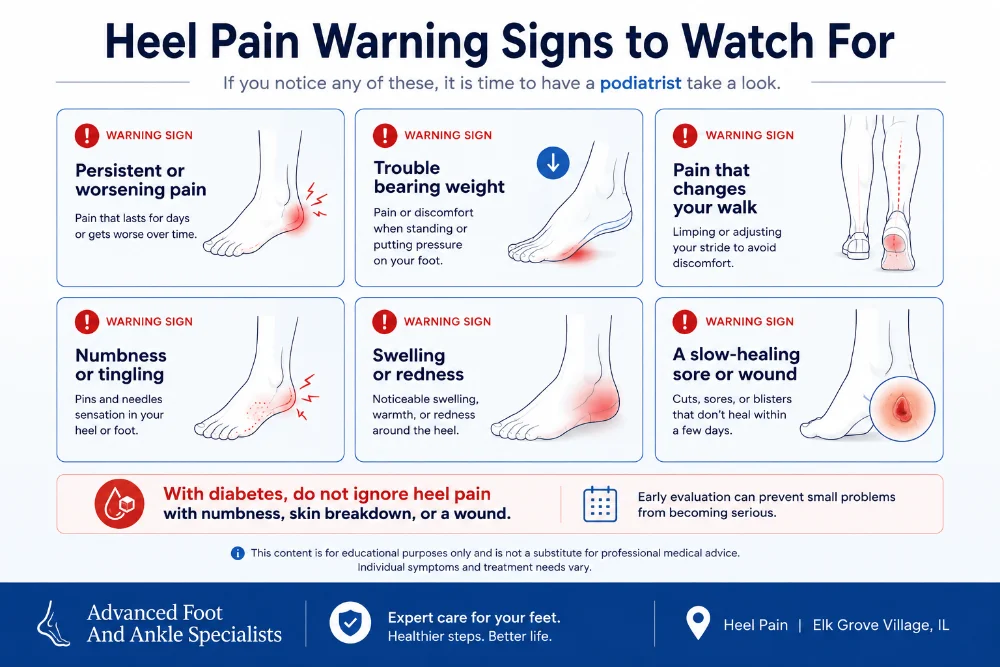
Not every ache needs an office visit on day one, but some signs mean it is time to be seen rather than wait it out. Watch for pain that is persistent or worsening, difficulty bearing weight, pain that changes the way you walk, numbness or tingling, swelling or redness, and a slow-healing sore or wound. If you have diabetes, do not ignore heel pain that comes with numbness, skin breakdown, or a wound, since problems there can become serious. Contact the office promptly if these symptoms appear. Seek urgent medical care for an inability to bear weight after an injury, visible deformity, rapidly increasing swelling, fever with redness or warmth, or an open wound or skin breakdown in a person with diabetes.
Heel pain care at the Elk Grove Village office follows a consistent path, from understanding the problem to choosing treatment that fits the cause. The four stages below describe how that works.
The podiatrist reviews when the pain began, how it developed, footwear, activity level, medical history, and what makes it better or worse. The exam includes checking the painful area, assessing foot structure, and looking at gait and movement to spot overpronation, flat feet, high arches, or uneven pressure. In-office X-ray or ultrasound may be used when clinically appropriate to evaluate fractures, tendon problems, or other possible causes.
Most heel pain is managed first with conservative steps. These can include resting or modifying activities that aggravate the heel, supportive footwear and arch support, orthotic inserts, stretching for the plantar fascia and calves, night braces that stabilize the foot during sleep, and medication to ease pain and inflammation. A referral to physical therapy may also be recommended.
Flat feet, high arches, overpronation, poor footwear, and uneven pressure can all contribute to heel pain and may be reasons it returns. Custom orthotics are prescription inserts designed from a foot exam, gait and pressure analysis, and 3D scanning. They may help redistribute pressure, support the arch and heel, and address foot mechanics that may be contributing to recurring symptoms.
When conservative care is not enough, the podiatrist may consider options such as ESWT, injections, or Tenex, depending on the diagnosis. Nerve decompression may be considered when nerve entrapment is contributing to the pain. Surgery is reserved for select situations that do not respond to other care. Not every treatment applies to every cause of heel pain, which is why the diagnosis guides the plan.


“Thank you for scheduling my same day appointment. After my two month long plantar fasciitis saga, on my first visit to Advanced Foot & Ankle, Dr. Halihan delivered the steroid injection that finally is alleviating my pain! Thank you!”
Heel pain overlaps with several conditions that each have their own dedicated page. If one of these turns out to be behind the pain, the linked page goes deeper while this page stays the broad diagnostic and treatment hub.
• Plantar Fasciitis. Irritation of the tissue along the bottom of the foot and one of the most common causes of heel pain.
• Heel Spurs. Bony growths on the heel bone that are often linked with plantar fasciitis.
• Achilles Tendon Injuries. Pain and stiffness at the back of the heel from the Achilles tendon.
• Fractures and Stress Fractures. Hairline or acute breaks that can cause heel and foot pain.
• Foot Injuries. Overuse and stress injuries that can involve the heel.
• Custom Orthotics. Prescription inserts that address the foot mechanics behind recurring heel pain.
• Foot Pain. General foot pain, when the source is not limited to the heel.
Once heel pain settles, a few habits can lower the chance it comes back. The practice pages point to supportive, well-fitting shoes for the activity, increasing running or high-impact exercise gradually so tissues can adapt, and daily stretching for the calves, Achilles, and plantar fascia. Warming up before exercise, maintaining a healthy weight, replacing worn athletic shoes, and using recommended orthotic support when foot mechanics are a factor may help reduce recurring strain. Resting from aggravating activity and icing the heel when pain first appears may also help prevent symptoms from worsening.
Heel pain care is delivered by board-certified podiatrists who complete a full evaluation before recommending treatment. Each provider trained in foot and ankle surgery and works from a conservative-first approach.
Dr. Halihan cares for heel pain patients across the practice's Elgin, Elk Grove Village, Huntley, and Montclare, Chicago offices. He earned his DPM from the Dr. William M. Scholl College of Podiatric Medicine in 2004 and completed a surgical residency at Michael Reese Hospital in Chicago, and he is certified by the American Board of Foot and Ankle Surgery in foot surgery and in reconstructive rearfoot and ankle surgery. His training includes wound care, diabetic limb salvage, and trauma and reconstructive surgery, and he is certified in STAR total ankle replacement. Patients often mention how clearly he explains what is causing their pain.
Dr. Khan treats heel pain with an emphasis on conservative management and an evidence-based approach to surgery. He earned his DPM from the Dr. William M. Scholl College of Podiatric Medicine in 2020 and completed his residency at Ascension Saint Joseph in Chicago, where he served as chief resident and received a leadership award, and he is certified by the American Board of Foot and Ankle Surgery in foot surgery and in reconstructive rearfoot and ankle surgery. His training spans foot and ankle trauma, sports medicine, arthroscopy, peripheral nerve surgery, reconstructive surgery, diabetic wound care, and limb salvage. He speaks English, Hindi, and Urdu.
Dr. Krouse is a Chicagoland native who cares for heel pain patients alongside the full range of foot and ankle conditions. He earned his DPM from the Dr. William M. Scholl College of Podiatric Medicine in 2013 and completed his residency at AMITA Health Saint Joseph Hospital in Chicago, where he served as chief resident, and he is certified by the American Board of Foot and Ankle Surgery in foot surgery and in reconstructive rearfoot and ankle surgery. His residency training covered wound care, trauma, complex reconstruction, limb salvage, Ilizarov external fixation, and peripheral nerve surgery, and he is certified in STAR total ankle replacement. He pairs surgical skill with a conservative, patient-first approach.
“Was in and out within a half hour. Quickly diagnosed and received proper treatment. The doc explained what was wrong and answered any questions I had.”
Which Advanced Foot and Ankle Specialists office should I visit for heel pain in Elk Grove Village? The Elk Grove Village office is in Suite 3004 of the Brock Medical Building at 800 Biesterfield Road, on the Ascension Alexian Brothers Medical Center campus. The same heel pain care is also available at the Elgin, Huntley, and Montclare, Chicago offices, so you can pick whichever is most convenient.
How do I know whether my heel pain is plantar fasciitis or something else? That is what the evaluation is for. Sharp pain beneath the heel that is worst with the first steps in the morning often points to plantar fasciitis, while pain behind the heel can suggest an Achilles problem. An examination and, when needed, imaging help identify the condition contributing to the pain.
What should I expect at my first heel pain visit? The podiatrist will ask about your symptoms, footwear, and activity, examine the painful area, and assess your foot structure and gait. In-office X-ray or ultrasound may be used when appropriate. You may leave with an initial diagnosis and treatment plan, although additional testing or follow-up may sometimes be needed.
Patients come to the Biesterfield Road office for heel pain from across Elk Grove Village and the surrounding northwest suburbs. Common areas include:
Elk Grove Village keeps people on their feet. Many work long shifts across the Elk Grove Village Business Park, while others log miles on the Busse Woods trails or spend the day standing behind a counter or moving through a warehouse. Heel pain has a way of turning those ordinary hours into a running calculation, from which shoes to wear to whether a shift will be bearable. Care on the Biesterfield Road campus is meant to shrink that disruption and help you stay as mobile as safely possible, and weekday hours, including a later Tuesday evening, make it easier to schedule a visit.
Call (847) 352-0200 or schedule a heel pain evaluation online with the Advanced Foot and Ankle Specialists team. Let the office know if the pain is worsening or if you have diabetes, numbness, skin breakdown, or a sore. The team can determine whether you should speak with a clinical staff member or seek more urgent evaluation. They can also confirm which of the Elk Grove Village, Elgin, Huntley, or Montclare, Chicago offices is most convenient and what to bring to a first visit.
Call (847) 352-0200 | Book Your Elk Grove Village Appointment
Advanced Foot and Ankle Specialists 800 Biesterfield Rd, Alexian Brothers Medical Center, Brock Medical Building, Suite 3004, Elk Grove Village, IL 60007
Common causes include plantar fasciitis, Achilles tendinitis, stress fractures, bursitis, nerve irritation, and other foot conditions. Heel spurs may be present on imaging but do not always cause symptoms. Because these can feel similar, an accurate diagnosis is what guides the right treatment.
Heel pain that is severe, constant, recurring, worsening, or interfering with normal walking should be evaluated. Swelling, redness, numbness, tingling, trouble bearing weight, or a slow-healing sore are added reasons to be seen sooner rather than later.
Persistent heel pain can become more limiting over time and may change the way you walk, placing extra stress on the ankles, knees, hips, or lower back.
Resting from aggravating activity, icing the heel, wearing supportive shoes, avoiding barefoot walking on hard floors, and gentle stretching may help some mild cases. Schedule an evaluation if the pain is worsening or does not improve. Seek care sooner if you have diabetes, numbness, skin breakdown, or a foot wound.
Heel pain is usually a mechanical or overuse problem rather than a diet issue, so the practice guidance centers on footwear, activity, stretching, and foot mechanics. Maintaining a healthy weight may help reduce pressure on the heel and plantar fascia.
Heel pain by itself is not a typical sign of heart disease and is more often related to a foot or soft-tissue condition. However, persistent swelling, significant color changes, numbness, or a nonhealing sore should be evaluated. Seek emergency care for chest pain, shortness of breath, fainting, or other symptoms of a possible cardiac emergency.
Gentle calf and plantar-fascia stretches may help some causes of heel pain. Strengthening exercises, heel raises, or rolling the foot should be used only when appropriate for the diagnosis, and the activity should be stopped if it increases pain. These are best started under guidance, and they are not a substitute for an evaluation when a specific problem may be present.
Plantar fasciitis occurs when the plantar fascia, the thick band of tissue that runs from the heel toward the toes and supports the arch, becomes irritated or inflamed. That usually follows repetitive strain, overuse, excessive pressure, or small tears, and the tissue may remain irritated when repetitive strain and pressure continue.
A sudden increase in activity, mileage, or intensity is a common trigger, along with unsupportive shoes, standing for long periods, tight calves, flat feet or high arches, and excess weight. Runners and people on their feet all day are among the most vulnerable.
Two hallmark signs are sharp pain at the bottom of the heel and pain that is worst with the first steps in the morning or after sitting. The discomfort may ease after warming up and then return after prolonged standing or activity.
Recovery varies by diagnosis and severity. Some mild cases improve over several weeks, while persistent or chronic conditions may require several months of treatment and gradual activity progression.
Most patients do not need surgery. Heel pain is usually managed with conservative and advanced nonsurgical care, while surgery is reserved for select cases that do not respond to other treatment. The plan begins with an evaluation of the underlying cause.
They can, especially when flat feet, high arches, overpronation, or uneven pressure are contributing. Custom orthotics are designed from a foot exam, gait and pressure analysis, and 3D scanning to redistribute pressure and support the arch and heel.
Yes. While this page focuses on Elk Grove Village, heel pain care is also available at the Elgin, Huntley, and Montclare, Chicago offices. Provider availability may vary by office and appointment date, so confirm the scheduled podiatrist when booking.
Extracorporeal shock wave therapy, or ESWT, applies acoustic energy to the affected tissue. The practice may consider it for selected cases of persistent heel pain that have not improved with conservative care.
For patients who want to read more, these Advanced Foot and Ankle Specialists guides go deeper into heel pain, plantar fasciitis, and everyday foot care.
• Plantar Fasciitis Recovery: A Complete Guide From Pain to Healing
• Your Guide to Podiatry: Conditions, Treatments, and When to Seek Care
• 10 Signs You Should See a Podiatrist Sooner Than Later
• Simple Podiatrist-Approved Exercises for Tired, Achy Feet
• The Complete Guide to Podiatry Services in Elgin, IL
If you want a podiatry team that will take the time to understand what is behind your heel pain, explain your options in plain language, and build a plan aimed at both easing the pain and keeping you moving through a full week on your feet, Advanced Foot and Ankle Specialists is ready to help. Whether it is first-step morning pain, a nagging Achilles, or heel pain that has lingered too long, reach out and let the Elk Grove Village team take a look.
Book Your Elk Grove Village Appointment | Call (847) 352-0200
Advanced Foot and Ankle Specialists 800 Biesterfield Rd, Alexian Brothers Medical Center, Brock Medical Building, Suite 3004, Elk Grove Village, IL 60007
Hours:

Our team is ready to help you feel your best, one step at a time!