Podiatrist in Chicago for Diabetic Foot Care, Heel Pain, Bunions, and Sports Injuries
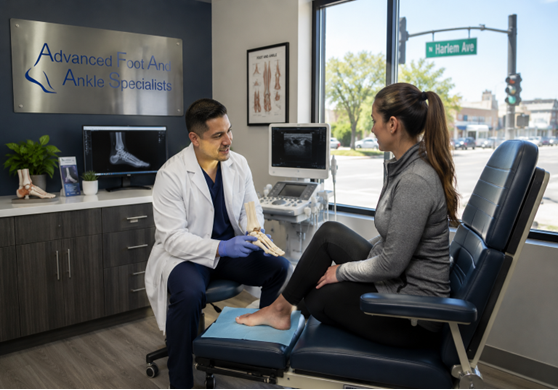
Foot and Ankle Care Built for Chicago's Northwest Side
Chicago is not short on places to send a sore foot, from urgent care clinics to general practitioners who fit podiatry in around everything else. What is harder to find is a dedicated foot and ankle practice where board-certified surgeons handle everything from a diabetic wound to a bunion to a torn Achilles under one roof. That is the space Advanced Foot and Ankle Specialists occupies on Harlem Avenue, pairing conservative, nonsurgical treatment as the first line with the surgical training to step in when a problem needs more than rest and orthotics.
The patients who come through the Montclare office tend to arrive with three kinds of problems. Some are managing diabetes and need consistent foot exams and wound care to stay ahead of complications. Others are dealing with the everyday wear of a walking city: heel pain from hard sidewalks, plantar fasciitis from long shifts on their feet, or a bunion that has finally started to hurt. A third group walks in after an injury, whether an ankle rolled on a Rutherford Sayre Park field or a fracture that needs imaging and a plan. Each starts with a thorough exam and a diagnosis before any treatment begins.
Reaching the Harlem Avenue Office From Across the Northwest Side
That Harlem Avenue address does more than sit close to home. It places a full slate of podiatry services in Chicago right on one of the Northwest Side's main corridors, minutes from the Brickyard Shopping Center on Diversey and the daily foot traffic of the Mont Clare Metra commute. A visit folds into the same loop as a grocery run, a school pickup, or the walk to catch the train downtown, rather than becoming a separate errand across the city.
For patients coming from just past the city line, the office is an easy reach too. Residents of Elmwood Park, River Grove, Norridge, Harwood Heights, and the Oak Park area regularly drive in along Harlem Avenue and Belmont, making the Montclare suite a practical option for the wider Northwest Side and near-west suburban pocket.
What Brings Northwest Side Patients Back to This Podiatry Practice
Patients who settle in with the practice tend to cite the same handful of reasons, most of them about depth of training and the range of care available in one place. The points below reflect how the Harlem Avenue team approaches foot and ankle care for Chicago patients.
- Three board-certified podiatric surgeons: Dr. Craig Halihan, Dr. Haris Khan, and Dr. Matthew Krouse are all certified by the American Board of Foot and Ankle Surgery in foot surgery and reconstructive rearfoot and ankle surgery
- Conservative care first: the team leans on nonsurgical options like orthotics, injections, physical therapy, and shockwave therapy before recommending surgery, and reserves procedures for cases that genuinely need them
- A real focus on diabetic foot care: diabetic foot exams, wound care, debridement, and limb salvage are core to the practice, which matters for the many Chicago patients managing diabetes
- In-office diagnostic imaging: on-site digital X-ray and ultrasound let the podiatrists diagnose fractures, soft tissue injuries, and conditions like plantar fasciitis during the same visit
- Surgical depth when it counts: the team performs bunion surgery, hammertoe correction, Achilles repair, arthroscopy, and STAR total ankle replacement for advanced cases
- Advanced laser options: the Q-Clear laser system offers a route to treat toenail fungus for patients who want to avoid long courses of oral medication
- Custom orthotics made to measure: 3D scanning, gait analysis, and biomechanical evaluation drive orthotics built for the individual foot rather than off-the-shelf inserts
- Sports and trauma experience: the podiatrists bring extensive training in foot and ankle trauma, sports medicine, and reconstruction to injuries from recreational leagues and everyday accidents
- A Northwest Side location with parking: the Harlem Avenue office near Harlem and Belmont is easy to reach by car or the Mont Clare Metra, with on-site suite parking
- Weekday evening availability: Tuesday hours run until 7:00 PM, which gives Metra commuters and working patients room to be seen after the day winds down

The Goals Behind Every Treatment Plan for Chicago Patients
Care at the Harlem Avenue office is organized around clear goals rather than one-off fixes. The four areas below are what most Chicago patients are working toward.
For patients managing diabetes, healthy feet are central to staying independent and out of the hospital. The podiatrists provide comprehensive foot exams, wound care, debridement, and limb salvage aimed at catching small problems before they turn into nonhealing ulcers or infections. Custom orthotics and preventive guidance help protect high-risk feet between visits. Consistent monitoring is the goal, since regular care is one of the most reliable ways to avoid serious diabetic foot complications.
Heel pain, plantar fasciitis, and Achilles trouble are some of the most common reasons Chicago patients walk in, often after months of hard sidewalks and long days on their feet. Treatment usually starts conservatively with stretching, orthotics, footwear changes, night splints, and anti-inflammatory measures. For stubborn cases, options like corticosteroid injections, shockwave therapy, or minimally invasive procedures may be considered. The aim is durable relief that lets patients get back to walking and standing comfortably.
When a bunion, hammertoe, or other deformity starts to hurt or limit shoe choices, the goal shifts to correcting the structure of the foot. The team begins with conservative measures like padding, orthotics, and footwear adjustments, and turns to surgery, including minimally invasive techniques, when conservative care is no longer enough. Each plan is built around the individual foot and how the patient wants to move afterward. Realistic expectations about recovery are set before any procedure.
Sprains, fractures, and sports injuries need an accurate diagnosis and a clear path back to activity. Using in-office X-ray and ultrasound, the podiatrists confirm what is injured and build a plan that may involve bracing, casting, physical therapy, or surgery for complex fractures. Rehabilitation is part of the plan, not an afterthought. The objective is a safe, complete return to work, sport, and daily life on the Northwest Side.
How the Practice Organizes Foot and Ankle Treatment
Care at the Harlem Avenue office falls into four working categories. Most patients start in one and draw from another as their treatment plan develops.
This category covers comprehensive diabetic foot exams, wound care, and debridement to remove dead tissue and support healing, along with offloading and limb salvage for high-risk feet. Custom orthotics help redistribute pressure and protect vulnerable areas. The podiatrists emphasize prevention and prompt treatment, since early attention is what keeps small diabetic foot issues from becoming serious.
Plantar fasciitis, heel pain, heel spurs, Achilles tendon injuries, arthritis, gout, and neuromas all fall here. Treatment typically begins with conservative measures such as orthotics, stretching, footwear changes, injections, and physical therapy. For persistent cases, the team may recommend shockwave therapy, cold laser therapy, or minimally invasive procedures. Ankle pain and foot pain are evaluated with a full exam and imaging before a plan is set.
For ingrown toenails, the practice offers conservative care, chemical nail removal, laser treatment, and surgical partial nail removal depending on severity. Toenail fungus can be addressed with the Q-Clear laser system, and plantar warts, calluses, and athlete's foot are treated with a range of topical, cryotherapy, laser, and in-office options. Each plan is matched to how advanced the condition is and the patient's overall foot health.
When structure or injury calls for a procedure, the podiatrists perform bunion surgery, including minimally invasive techniques, hammertoe correction, fracture repair, arthroscopic ankle procedures, and STAR total ankle replacement. Sports injuries and trauma are managed from diagnosis through rehabilitation. Surgery is recommended only after conservative options have been weighed, and every surgical plan includes a clear discussion of recovery.
The Full Range of Podiatry Services for Chicago Patients
- Comprehensive diabetic foot exams and preventive care
- Diabetic wound care and debridement
- Limb salvage for high-risk and nonhealing wounds
- Custom orthotics with 3D scanning and gait analysis
- Plantar fasciitis treatment, including orthotics and minimally invasive options
- Heel pain and heel spur treatment
- Extracorporeal shock wave therapy for chronic heel pain
- Achilles tendon injury care
- Ankle pain evaluation and arthroscopic treatment
- Foot and ankle fracture care with casting, bracing, or surgery
- Sports injury evaluation and rehabilitation
- Bunion surgery, including minimally invasive techniques
- Hammertoe treatment, conservative and surgical
- Ingrown toenail treatment: conservative, chemical, laser, and surgical
- Toenail fungus treatment with the Q-Clear laser system
- Plantar wart treatment with cryotherapy, laser, or topical care
- Callus treatment
- Athlete's foot treatment
- Neuroma treatment, including orthotics, injections, and neurolysis
- Arthritis treatment for the foot and ankle
- Gout treatment and management
- Foot pain diagnosis with X-ray, ultrasound, and referral imaging
- Cold laser therapy for pain from multiple foot and ankle conditions
- STAR total ankle replacement for advanced arthrit
The Board-Certified Podiatrists Caring for Chicago Patients
Every appointment at the Harlem Avenue office is handled by one of three board-certified podiatric surgeons. Their training runs from diabetic wound care and limb salvage to complex reconstructive foot and ankle surgery.
Dr. Craig Halihan is a board-certified podiatrist with specialized training in wound care, diabetic limb salvage, and trauma and reconstructive surgery. He completed undergraduate studies in psychology and biology at the University of Illinois at Chicago, then earned his DPM in 2004 from the Dr. William M. Scholl College of Podiatric Medicine at Rosalind Franklin University. He completed a surgical residency at Michael Reese Hospital in Chicago and is certified by the American Board of Foot and Ankle Surgery in both foot surgery and reconstructive rearfoot and ankle surgery, as well as STAR total ankle replacement. Outside the office, he enjoys ice hockey and home improvement projects.
Dr. Haris Khan built his practice around conservative management paired with an evidence-based approach to surgery. He completed his undergraduate degree in biology at the University of Illinois at Chicago and earned his DPM in 2020 from the Dr. William M. Scholl College of Podiatric Medicine at Rosalind Franklin University. He finished a demanding surgical residency at Ascension Saint Joseph in Chicago, where he served as chief resident and earned the residents' leadership award, with training spanning trauma, total ankle replacement, reconstruction, arthroscopy, sports medicine, and diabetic wound care. He is certified by the American Board of Foot and Ankle Surgery and speaks Hindi and Urdu in addition to English.
Dr. Matthew Krouse is a Chicagoland native who brings broad expertise across podiatric medicine and surgery. He completed his undergraduate studies at Indiana University and earned his DPM from the Dr. William M. Scholl College of Podiatric Medicine at Rosalind Franklin University. He completed his residency at Saint Joseph Hospital in Chicago, serving as chief resident, with specialized training in wound care, trauma, complex reconstruction, limb salvage, external fixation, and peripheral nerve surgery. He is certified by the American Board of Foot and Ankle Surgery and in STAR total ankle replacement, and he enjoys golf, tennis, and time with family when he is not seeing patients.
Quick Answers for Patients Planning a First Visit in Chicago
Where exactly is the Chicago office located? The office is at 3115 N Harlem Ave, Suite 200, in the Montclare neighborhood on the Northwest Side, near the Harlem and Belmont intersection. It is a short drive from Dunning, Belmont Cragin, and Galewood, and close to the Mont Clare Metra Station and Rutherford Sayre Park.
Do you offer evening hours for people who work or commute during the day? Yes. Tuesday hours run until 7:00 PM, which gives commuters and working patients a chance to be seen after the workday. The other weekdays run in the daytime, so the front desk can help you find a window that fits your schedule.
Is parking available at the Harlem Avenue office? Yes. Suite parking is available at the 3115 N Harlem Ave location, so you do not need to search for street parking before your appointment. The front desk can confirm building access and directions when you book.
Northwest Side Neighborhoods and Nearby Communities We See Patients From
Patients reach the Harlem Avenue office from across the Northwest Side of Chicago and the neighboring communities just past the city line. Common origin points include:
- Chicago, IL (60634)
- Montclare
- Dunning
- Belmont Cragin
- Galewood
- Portage Park
- Belmont Heights
- The Harlem and Belmont corridor
- Rutherford Sayre Park area
- Mont Clare Metra Station area
- Brickyard Shopping Center area
- Elmwood Park
- River Grove
- Norridge
- Harwood Heights
- The Oak Park area
How a Harlem Avenue Podiatry Office Fits a Northwest Side Week
Life on the Northwest Side puts a lot of miles on your feet. There is the walk to the Mont Clare Metra and the standing on hard platforms, the concrete sidewalks between errands, the aisles at the Brickyard Shopping Center, and weekend games and walks around Rutherford Sayre Park. Add a Chicago winter of icy footing and heavy boots, and small foot problems have a way of becoming daily ones. A podiatry office right on Harlem Avenue means addressing that heel pain or diabetic foot concern does not require crossing the city, and the Tuesday evening hours are there so a train commute or a full workday does not have to stand between you and getting seen.
What Recent Chicago Patients Have Said About the Practice
“Everyone was so nice! From the receptionist, nurses, and doctor, I felt comfortable and at ease. I will definitely be back for all my podiatry needs.”
- Jenniffer Cortes
“Dr. Matthew K. was friendly and helped me with my problem fairly quickly and with ease. Would recommend Matthew and the office. Waiting time was acceptable, arriving on time.”
- Jose Luis Flores
“Dr. Halihan is amazing! The best podiatrist I've ever been to. Very professional, friendly, talkative, and very down to earth. I highly recommend Dr. Halihan for any of your foot needs! The staff is also very professional and friendly. This is a great podiatrist office I will absolutely recommend to my family and friends!”
- Doel Polanco
Set Up a Chicago Foot and Ankle Visit in a Few Minutes
Call (773) 836-9900 or schedule online to start a consultation conversation with the Advanced Foot and Ankle Specialists team. The front desk can match you with the right podiatrist for your concern, whether that is diabetic wound care, a painful bunion, or a sports injury, and help you plan a time that works around your Metra commute or the drive in along Harlem Avenue.
Address: 3115 N Harlem Ave, Suite 200, Chicago, IL 60634
Hours: Monday, 9:00 AM to 5:00 PM. Tuesday, 9:00 AM to 7:00 PM. Wednesday, 9:00 AM to 4:00 PM. Thursday and Friday, 9:00 AM to 5:00 PM. Closed Saturday and Sunday.
Call (773) 836-9900 | Book Your Chicago Appointment
Advanced Foot and Ankle Specialists 3115 N Harlem Ave, Suite 200, Chicago, IL 60634
Common Questions About Seeing a Podiatrist in Chicago
How long does a diabetic foot wound take to heal?

Healing time depends on the size and depth of the wound, your circulation, and how well blood sugar is managed, so it can range from a few weeks to several months. Consistent wound care, offloading pressure, and keeping follow-up visits are the most reliable ways to support healing. Your podiatrist will monitor progress and adjust the plan as needed.
How treatable is a diabetic foot condition?
Many diabetic foot problems respond well to treatment when they are caught early, which is why regular foot exams matter so much. Wound care, custom orthotics, and preventive guidance can help protect the foot and lower the risk of serious complications. Outcomes are strongest when podiatric care is paired with good overall diabetes management.
What are the four stages of diabetic foot problems?
Clinicians often describe diabetic foot changes as a progression, from healthy feet at risk, to loss of sensation or circulation, to skin breakdown and ulceration, and finally to infection or deeper tissue damage if left unaddressed. Knowing where a foot falls on that path helps guide treatment. Your podiatrist can explain your individual risk during an exam.
What foot problems are common with diabetes?
Diabetes can lead to nerve damage, poor circulation, slow-healing wounds and ulcers, infections, and changes in foot structure over time. Reduced sensation means small injuries can go unnoticed until they become serious. Routine podiatric care is designed to catch these issues early.
What is the root cause of plantar fasciitis?
Plantar fasciitis usually comes from repeated strain on the band of tissue along the bottom of the foot, often tied to tight calf muscles, poor arch support, long hours standing, or a sudden increase in activity. Hard surfaces and unsupportive shoes can make it worse. A podiatrist can pinpoint the contributing factors and target them.
What makes plantar fasciitis worse?
Standing or walking for long stretches on hard surfaces, wearing worn or unsupportive shoes, tight calves, and pushing through the pain all tend to aggravate plantar fasciitis. Those first steps in the morning are often the most painful. Addressing footwear, stretching, and support early usually helps prevent it from becoming chronic.
How painful is bunion surgery?
Most patients experience manageable discomfort after bunion surgery that is controlled with prescribed or over-the-counter medication and elevation during the first several days. Minimally invasive techniques can reduce tissue disruption and may support a smoother recovery in suitable cases. Your surgeon will review what to expect based on your specific procedure.
How do you know if a bunion is severe?
Signs of a more advanced bunion include persistent pain, a large or stiff bump at the base of the big toe, difficulty fitting into shoes, and overlapping toes. Imaging helps measure the degree of misalignment. A podiatrist can tell you whether conservative care is still enough or whether surgery is worth considering.
What happens if an ingrown toenail goes untreated?
An untreated ingrown toenail can become inflamed and infected, and for people with diabetes or poor circulation it can lead to more serious complications. What starts as minor irritation may progress to persistent pain and drainage. Prompt treatment, from conservative care to a minor in-office procedure, usually resolves it quickly.
What is the best treatment for heel pain?
The right treatment depends on the cause, but most heel pain improves with a combination of rest, stretching, supportive footwear, custom orthotics, and anti-inflammatory measures. Persistent cases may benefit from night splints, shockwave therapy, or other targeted options. An exam is the best way to identify the source and match the treatment to it.
Does Chicago winter weather make foot and ankle pain worse?
Cold weather can stiffen joints and aggravate conditions like arthritis, and icy sidewalks raise the risk of slips, sprains, and fractures. Heavy winter boots that lack support can also worsen heel and arch pain. Supportive footwear and cautious footing help, and a podiatrist can address pain that flares in the colder months.
Can commuting on foot and standing on Metra platforms cause plantar fasciitis or heel pain?
Yes, long periods of walking and standing on hard surfaces are common contributors to plantar fasciitis and heel pain, which is a familiar pattern for Northwest Side commuters. Supportive shoes and orthotics can reduce the strain of a daily walk to the train. If pain is already present, an evaluation can help before it becomes chronic.
Do you treat running and sports injuries for active Northwest Side residents?
Yes, the podiatrists have extensive training in foot and ankle sports injuries and trauma, from ankle sprains and stress fractures to tendon injuries. Care combines accurate diagnosis with in-office imaging and a rehabilitation plan aimed at a safe return to activity. Whether the injury happened at Rutherford Sayre Park or on a weekend run, the goal is getting you back on your feet.
Are custom orthotics covered by insurance, and how are they made?
Coverage varies by plan, so the front desk can help you check your specific benefits before treatment. Custom orthotics at the practice start with a consultation, gait and biomechanical analysis, and 3D scanning, followed by a design matched to your foot and a fitting with follow-up adjustments. This process produces support tailored to you rather than a generic insert.
When should I see a podiatrist instead of waiting for foot pain to go away?
It is worth being seen when pain lasts more than a week or two, keeps returning, or interferes with walking, work, or sleep, and sooner if you have diabetes or notice swelling, numbness, or a wound. Early care often means simpler treatment and a faster recovery. Waiting can allow a minor problem to become a chronic one.
Do you offer laser treatment for toenail fungus?
Yes, the practice uses the Q-Clear laser system, which heats the nail to target the fungus and can be a good option for patients who want to avoid oral antifungal medication. It typically takes a few sessions, and results become visible as healthy nails grow over the following months. Your podiatrist can advise whether it is a good fit for your case.
Foot and Ankle Care That Fits How Chicago Patients Actually Live
If you want a practice that takes the time to understand what is really going on with your feet, walks you through your options in plain language, and cares about both relieving your pain and keeping you moving through daily life, the Harlem Avenue office is a good place to start. From diabetic foot care and heel pain to bunion correction and sports injuries, the board-certified team builds a plan around your foot, your schedule, and your goals. Reach out whenever you are ready and they will take it from there.
Start Your Foot and Ankle Care in Chicago Today
Book Your Chicago Appointment | Call (773) 836-9900
Advanced Foot and Ankle Specialists 3115 N Harlem Ave, Suite 200, Chicago, IL 60634
https://www.afaasonline.com/
Hours:
Monday: 9:00 AM to 5:00 PM
Tuesday: 9:00 AM to 7:00 PM
Wednesday: 9:00 AM to 4:00 PM
Thursday and Friday: 9:00 AM to 5:00 PM
Saturday and Sunday: Closed